


What is carotid artery disease?
Your carotid arteries are the two main arteries that carry blood from your heart, up through your neck, and into your brain. Healthy carotid arteries are smooth and open, delivering the oxygen, glucose, and nutrients your brain needs to work well.
As you age, a buildup of fat and cholesterol called plaque can stiffen the artery walls. This “hardening of the arteries,” or atherosclerosis, narrows the artery and restricts blood flow. The narrowing is called carotid artery stenosis, and it raises the risk of stroke.
Your brain's blood supply
Plaque narrows them
Often silent

How it develops
Nearly always, it comes down to plaque slowly narrowing the arteries that carry blood to your brain.
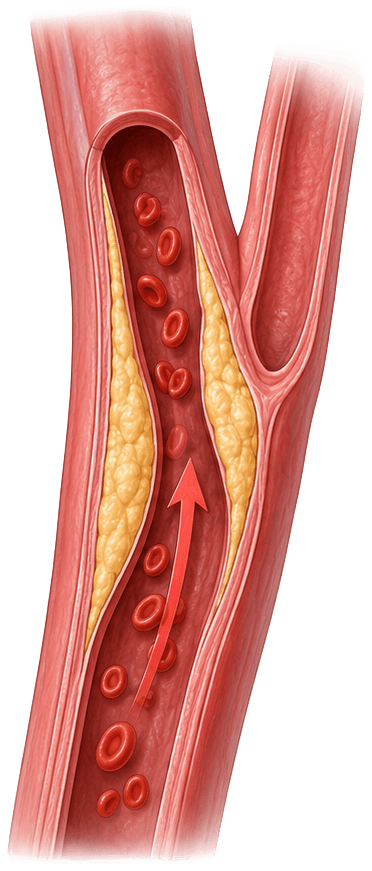
Plaque builds up
Over the years, fat and cholesterol collect along the inner walls of the carotid arteries and slowly harden into plaque.
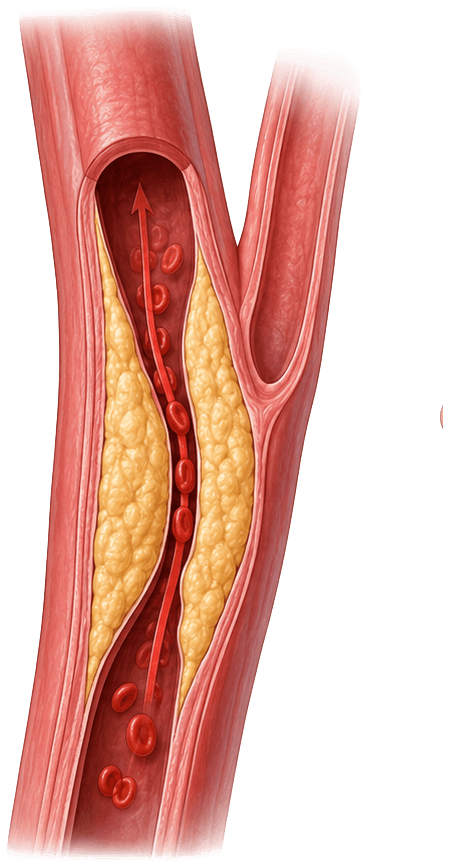
The artery narrows
As plaque thickens, the carotid artery stiffens and its channel narrows.
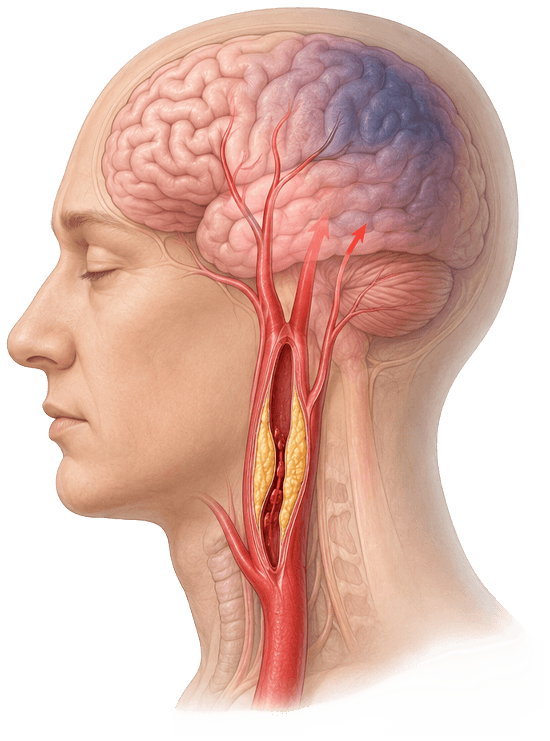
Blood flow drops
The narrowing restricts oxygen-rich blood reaching the brain and raises the risk of a mini-stroke or stroke.
Who's most at risk
Carotid artery disease shares its risk factors with heart disease and stroke. The more that stack up, the higher your risk, and the more reason to get screened.
The same habits that protect your heart and brain protect your carotid arteries too: staying active and managing blood pressure, cholesterol, and blood sugar.
Age over 65
High blood pressure
High cholesterol
Diabetes
Heart disease
Smoking, weight & inactivity
Signs & symptoms
When carotid disease does cause signs, they usually arrive as a TIA (a “mini-stroke”) or a stroke, which is why finding it early matters so much.
A TIA usually resolves within 24 hours, but it’s an important warning of higher stroke risk. The signs to watch for are the signs of a stroke:
Call 911 right away
If you or someone near you has any of these signs, get to the nearest emergency room right away.
How we diagnose it
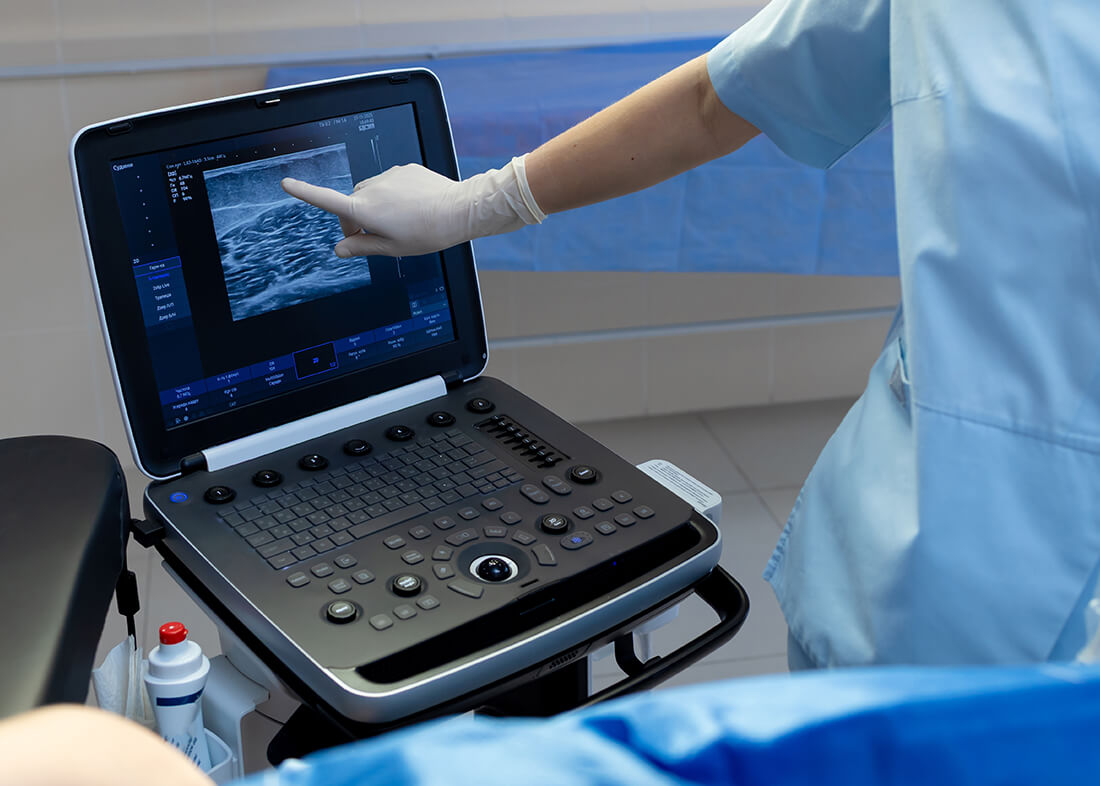
It starts with the most important test: a quick, painless carotid ultrasound, available at every office.
Exam & history
A specialist reviews your history and risk factors, then listens over the artery with a stethoscope for a bruit, the whistling sound of blood passing a narrowing.
Carotid Doppler ultrasound
An ultrasound in our accredited vascular lab measures how narrowed the artery is and how well blood is reaching the brain.
MRA or arteriogram
When more detail is needed, advanced imaging maps the artery precisely so your surgeon can plan the safest treatment.
How we treat it
Care ranges from managing risk factors to advanced, minimally invasive procedures, matched to how narrowed your arteries are and your overall health.
Medical management
Managing blood pressure, cholesterol, and blood sugar, quitting smoking, and taking clot-preventing (antiplatelet) medicine can slow the disease and lower stroke risk.
Carotid endarterectomy
A vascular surgeon removes the plaque from inside the artery through an incision in the neck. This is the traditional open procedure.
Carotid artery stenting
A stent is placed through a catheter to hold the narrowed artery open, without open surgery.
TCAR
Gold standardTranscarotid artery revascularization briefly reverses blood flow to protect the brain while a stent is placed. It's minimally invasive, with no general anesthesia.
Not everyone needs a procedure: usually only patients with significant narrowing (about 75% or more) or recent symptoms. Your vascular surgeon will recommend the right plan for you.
Carotid artery disease, answered
The questions patients ask us most about carotid disease and TCAR.
If you're concerned about carotid stenosis or your risk of stroke, start by discussing it with your physician, who will take a detailed history and exam. And if you have risk factors, they can order a noninvasive carotid ultrasound to check for plaque buildup in the artery.
No, surgery isn't required for everyone with carotid stenosis, and even when it is, it's rarely an emergency. You'll likely be referred to a vascular surgeon. Typically only patients with significant plaque (usually 75% or greater) or recent symptoms of a TIA or stroke are recommended for a procedure.
A board-certified vascular surgeon is uniquely qualified to treat carotid artery stenosis. They have the experience and access to every treatment option, including carotid endarterectomy (surgery) and minimally invasive options such as carotid stenting and TCAR. From there, they'll recommend the best approach for you.
TCAR is our most advanced option for higher-risk patients: it protects the brain during treatment, avoids general anesthesia, and is done through a small incision at the base of the neck. Our TCAR page walks through how it works, who it's for, and what recovery looks like.
Carotid care is a core specialty here, not an occasional procedure. Our fellowship-trained vascular surgeons offer every option, from medical management to endarterectomy, stenting, and TCAR. They recommend a procedure only when the narrowing truly calls for one, and follow you with regular ultrasounds afterward. That mix of experience and conservative judgment is why physicians across Southern California refer their carotid patients to us.
Insurance
When your veins cause symptoms like aching, swelling, or skin changes, treatment is typically considered medically necessary, including under Medicare. We'll help you verify your benefits.
Most major plans accepted






Locations
Care close to home across the Inland Empire, High Desert, and Coachella Valley. Every office has on-site ultrasound.
High Desert
Coachella Valley
Expert carotid care, close to home.
Talk with our fellowship-trained vascular surgeons about your carotid arteries and the right treatment for you. Screening offered at all 6 of our Southern California offices.